

How can Europe ensure that advances in cancer research translate into better-informed clinical decisions and more equitable outcomes for patients? This question was at the centre of the European Alliance for Personalised Medicine’s (EAPM) contribution to DIGICORE’s Connect to Win 2026 meeting, held in collaboration with IPO-Porto on 2–3 November.
The meeting brought together cancer centres, researchers and partners to explore how a stronger European research network can help make precision oncology more consistently available across healthcare settings. Discussions focused not only on scientific progress, but also on the conditions needed to translate research findings into clinical practice.
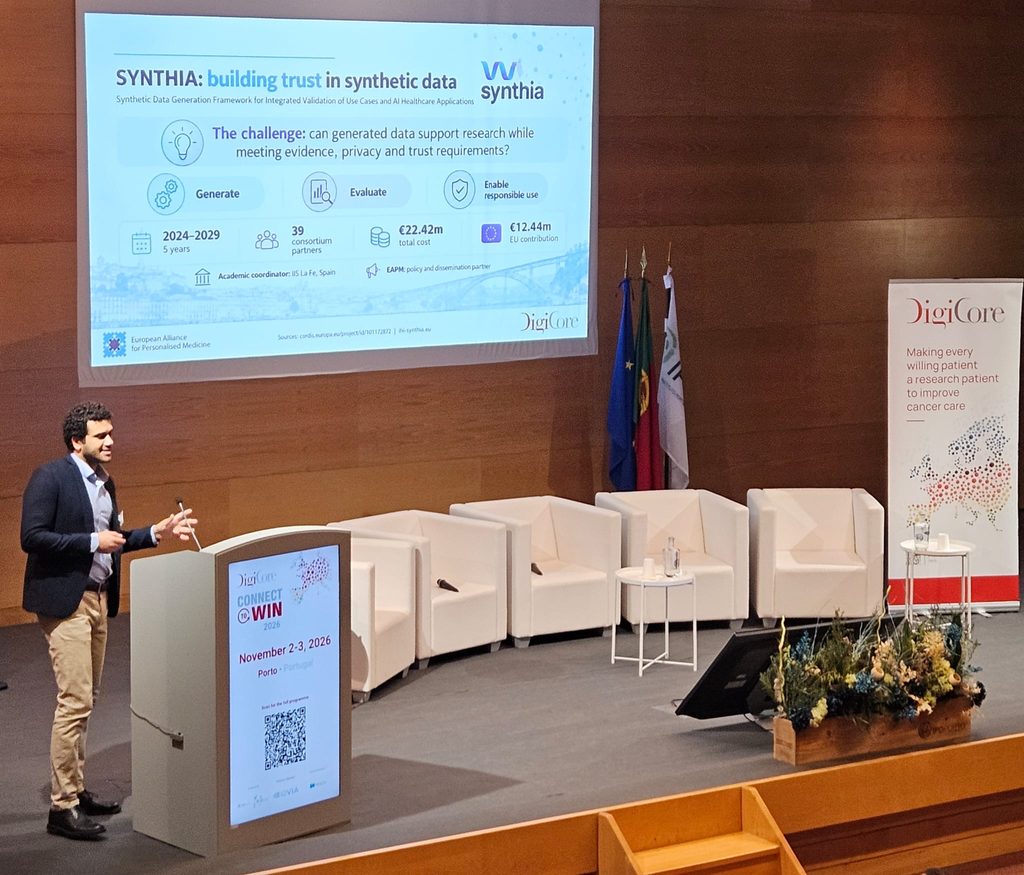
Representing EAPM, Abdelrahman Taha contributed to Session 5 with a presentation entitled From Evidence to Implementation: A Patient and Policy Perspective on Personalised Medicine. His contribution examined the patient journey from initial testing and the interpretation of results through to treatment decisions and follow-up, highlighting the points at which promising scientific advances may fail to deliver their intended benefit.
Connecting research, clinical practice and patient needs
A central message of the presentation was that the value of personalised medicine cannot be measured by scientific progress alone. A test, biomarker or new analytical approach only reaches its full potential when the resulting evidence can inform decisions about an individual patient’s care.
This requires more than access to innovative technologies. It depends on the availability of appropriate testing, reliable interpretation of results, clinical expertise, effective care pathways and the policy frameworks needed to support their implementation.
Four European research projects illustrated different dimensions of this challenge.
SPARC is working to improve access to molecular testing and clinical expertise, addressing important requirements for the delivery of personalised cancer care.
BRECISE is examining how biomarker evidence can support clinical decision-making and facilitate the adoption of new approaches in practice.
IHI-SYNTHIA is developing approaches to the generation and assessment of synthetic health data, exploring their potential contribution to research while considering the importance of data quality and reliability.
iBeCHANGE is testing personalised approaches to prevention and healthier behaviours, demonstrating how individualised interventions can also contribute to improving health outcomes before disease develops.
Although their areas of focus differ, these initiatives share an important consideration: innovation must be designed with its eventual use in mind. Patient involvement, clinical requirements and policy decisions all influence whether new approaches can be adopted, trusted and sustained within healthcare systems.
Real-world evidence and the role of emerging technologies
The exchange with DIGICORE’s community extended the discussion to the evidence needed to assess whether innovation is making a meaningful difference to patients.
Real-world evidence was one important area of focus. Beyond demonstrating that a diagnostic test or treatment is scientifically valid, healthcare systems need to understand whether patients are actually receiving the appropriate tests, whether the results influence subsequent clinical decisions and whether this leads to changes in their care.
The discussion also explored the potential contribution of patient digital twins and synthetic data to cancer research. These approaches may create new opportunities to support research and generate insights, but their application raises important questions about the quality of the underlying data, the reliability of the models and their suitability for specific purposes.
Establishing trust in these tools will require appropriate assessment and validation, alongside a clear understanding of how their outputs can be used to support research and clinical practice.
Europe’s investment in health innovation must deliver across health systems
The meeting also provided an opportunity to consider the broader policy and funding environment shaping Europe’s research landscape. In particular, participants discussed the proposed European Competitiveness Fund and the geopolitical pressures influencing the next funding cycle.
For EAPM, these developments reinforce the importance of looking beyond investment in research and technological development alone. Europe’s ability to translate scientific advances into better healthcare will also depend on the infrastructure, collaboration and implementation capacity available across its health systems.
Funding priorities should therefore take into account the entire pathway from research and evidence generation to clinical adoption and patient access. This includes strengthening research infrastructure, supporting collaboration between centres and ensuring that access to advanced diagnostics and expertise does not depend on where a patient lives or receives care.
Ultimately, the success of personalised medicine will depend on whether scientific progress can be translated into more timely, informed and equitable decisions for patients.
EAPM thanks DIGICORE and IPO-Porto for the invitation and for bringing together the research community to address these important questions. The discussions at Connect to Win 2026 offered a valuable opportunity to consider how European collaboration can help bridge the gap between evidence and implementation, ensuring that innovation delivers tangible benefits across cancer care.