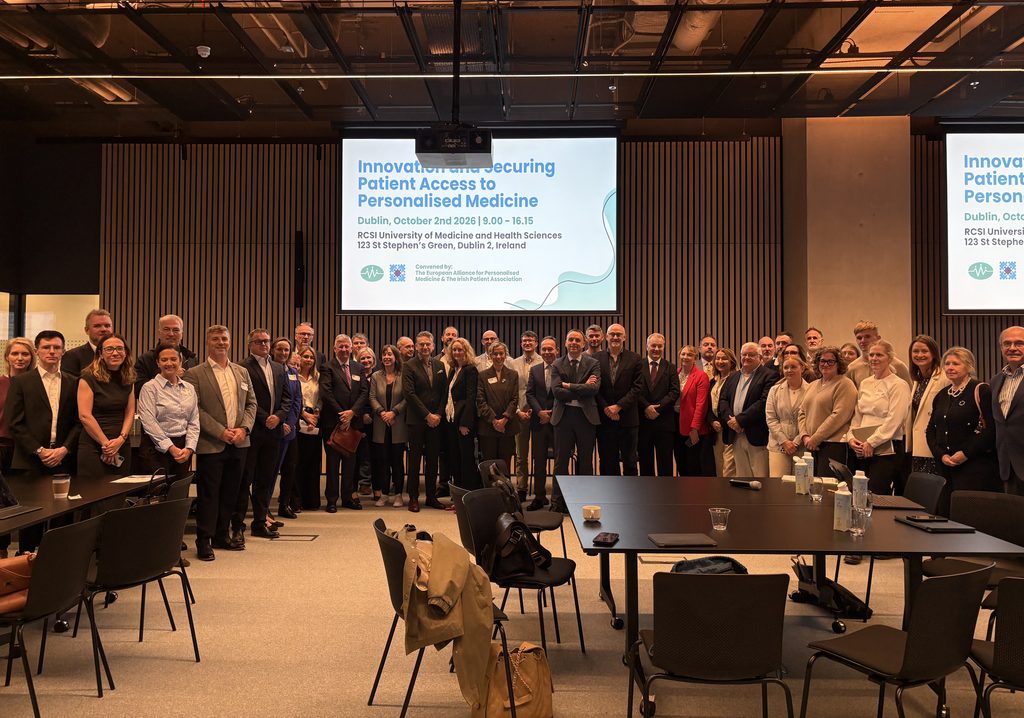
Dublin, 2 October 2026 – The European Alliance for Personalised Medicine (EAPM) & The Irish Patients Association brought together stakeholders from across healthcare, research, industry, patient organisations and policy in Dublin on October 2nd to examine how Europe can move personalised medicine from scientific and technological innovation towards routine, equitable patient benefit.
Held during the Irish Presidency, the conference “Innovation and Securing Patient Access to Personalised Medicine” focused on a challenge that increasingly sits at the centre of European health policy: scientific progress alone does not guarantee that patients will benefit from innovation.
Europe has world-class research capabilities, strong regulatory expertise and a leading life-sciences sector. Yet significant barriers remain between innovation and implementation, including fragmented reimbursement pathways, uneven diagnostic capacity, limited data infrastructure, workforce constraints and insufficient alignment between research, regulation, health technology assessment, clinical practice and patient needs.
Closing the last mile
The concept of the “last mile of implementation” provided an important starting point for the discussions in Dublin. Moving personalised medicine into routine care requires more than developing new technologies or securing regulatory approval. It requires health systems to be ready to evaluate, finance, adopt and integrate innovation, while ensuring that patients can actually access the resulting services and treatments.
The opening discussion brought together European and national policy perspectives, including contributions from Olivér Várhelyi, European Commissioner for Health and Animal Welfare, and Vytenis Andriukaitis MEP, Rapporteur for the Biotech Act in the European Parliament’s Committee on Public Health.
The discussion also highlighted the importance of connecting European innovation policy with health-system realities and patient needs. Contributions from the European Commission Joint Research Centre, industry and the patient community underlined the need for a more integrated approach to personalised medicine, in which scientific progress, digital technologies, clinical practice and access are considered as part of the same pathway.
From innovation to implementation
A recurring theme throughout the conference was the need to strengthen the pathway between research, evidence generation and real-world adoption.
Participants considered the potential role of new approaches to health innovation funding in supporting early adoption and evidence generation, particularly where transformative technologies face difficulties moving beyond research or regulatory approval into routine care. The discussion also examined how different disease areas and patient pathways can experience these barriers differently, reinforcing the importance of designing innovation and access mechanisms around real-world healthcare needs.
Diagnostics were another central part of this discussion. Advances such as liquid biopsy, digital pathology and AI-enabled workflows are creating new opportunities for earlier diagnosis, molecular stratification, treatment selection and disease monitoring. However, their impact depends on the infrastructure surrounding them, including laboratory capacity, validation, reimbursement, interoperability, data governance, workforce expertise and integration into clinical pathways.
The conference therefore placed considerable emphasis on the distinction between having an innovation and being able to use it effectively. A diagnostic technology, treatment or clinical innovation can only deliver patient benefit when the health system has the capacity to identify the appropriate patients, generate and interpret the necessary evidence, make decisions based on that evidence and provide access to the resulting intervention.
Aligning evidence, health systems and patient access
The same implementation challenge applies to clinical research. Increasingly sophisticated clinical trial designs and growing use of real-world evidence are generating new forms of evidence for personalised medicine. Yet differences between global research programmes and national regulatory, HTA and reimbursement systems can create delays between successful research and local patient access.
The discussions in Dublin highlighted the importance of improving alignment across these stages, while also recognising that access cannot be considered independently of equity. Differences in health-system capacity, diagnostic readiness and evidence requirements can result in very different timelines and opportunities for patients depending on where they live.
This made the participation of a broad range of stakeholders particularly important. The conference brought together clinicians, researchers and scientists, patient advocates, industry representatives, health-system experts and policymakers, allowing questions of innovation and access to be considered from different points along the patient and healthcare pathway.
The wider policy and economic environment
The ability of Europe to deliver personalised medicine is also increasingly connected to developments beyond traditional health policy.
Trade tensions, tariffs, supply-chain resilience, international pricing pressures and the debate around Most-Favoured-Nation pricing can all influence the environment in which medicines, diagnostics, technologies and other components of personalised healthcare are developed, manufactured and made available.
The closing discussion considered how Europe can strengthen competitiveness, affordability and strategic autonomy while maintaining the investment, innovation and international cooperation needed to ensure timely access for patients.
This broader perspective reflects the increasingly interconnected nature of personalised medicine. Access depends not only on what happens within hospitals and laboratories, but also on the policy, economic and industrial conditions that underpin healthcare systems.
A shared focus on patient benefit
Across the discussions, the central issue remained the same: how can Europe ensure that scientific and technological progress translates into measurable benefits for patients?
Answering that question requires stronger connections between research and clinical practice, better diagnostic and data infrastructure, sustainable approaches to financing and reimbursement, health-system readiness and meaningful patient involvement. It also requires greater coordination between health policy and the wider industrial, trade and economic frameworks that increasingly shape access to innovation.
The Dublin conference provided an opportunity to bring these perspectives together and examine the implementation challenge from multiple angles. The strong participation from different parts of the health ecosystem also demonstrated the value of creating spaces where these issues can be considered collectively rather than in isolation.
The conversation will continue in the coming weeks, with EAPM sharing further insights and key takeaways from the discussions and exploring what they mean for the future implementation of personalised medicine in Europe.